Featured Video
Tae-won (Tony) Chey on the 15-Year Bet Behind SK hynix’s Nasdaq Listing and the Future of AI Infrastructure
Tae-won (Tony) Chey, Chairman of SK Group, joins Daniel Newman at Nasdaq in New York following SK hynix’s ADR listing to trace the strategic decisions, from the 2012 Hynix Semiconductor Inc. acquisition to the 2019 push into AI, that positioned SK Group at the center of today's AI memory market.
All Videos
Why Unified Orchestration Is Becoming Its Own Category
On the Six Five Virtual Webcast, Kestra's Kai Waehner explains how AI agents acting across fragmented automation are moving governance out of individual tools and into a unified orchestration layer. Enterprises that define accountability, access control, and sovereignty requirements in that layer first can scale agents without losing end-to-end control.


Windows Goes Hybrid, Marvell’s $90B Target, and the AI Routing Race | The Six Five Pod Ep. 323
On Episode 323 of The Six Five Pod, Patrick Moorhead and Daniel Newman unpack the biggest stories from the week, including Microsoft and NVIDIA’s hybrid intelligence push for Windows, Marvell’s Investor Day, new models from Anthropic, Mistral, and Reflection, the AI labs’ accountability hearings in New York and Australia, Google’s model-neutral Gemini agent, and whether temporary construction jobs justify AI data centers. Plus, Bulls & Bears covers Thursday’s chip-led pullback, NVIDIA’s run past $240, and Samsung’s record Q3 guidance.
What Happens When AI Starts Designing the Chips That Power It | Synopsys at AI Infra Summit
At AI Infra Summit 2026, Synopsys' Thomas Andersen joins Brendan Burke and Matt Kimball to explain how chip design is moving from AI copilots that suggest to agentic systems that execute tool orchestration, timing fixes, and verification from a written spec. For enterprises, that shift compresses spec-to-tapeout timelines and lowers the resource barrier to custom silicon.
The Six Five Pod | EP 322: AI Writes Its Own Rules, Copilot Bills by the Task, and Memory Names Its Price
The companies racing to build frontier AI just agreed to referee themselves. Over the same week, launches, investor days, and earnings put a price on that arrangement. Microsoft is charging for finished work, NVIDIA is selling agent containment as infrastructure, and the suppliers AI can't route around, from Synopsys to Micron, are collecting the premium. Patrick Moorhead and Daniel Newman separate signal from stagecraft, then split hard on whether the White House accord actually binds these key players to anything.
The Major Decision Hiding Behind Every Hypervisor Renewal
HPE's Varma Kunaparaju talks with Patrick Moorhead and Daniel Newman about why virtualization licensing changes are forcing enterprises to confront a bigger decision than which hypervisor to choose next: what operating model sits underneath their private cloud and AI factory. He outlines how CxOs can sequence modernization in phases, extend governance across open and frontier models, and decide where automation should replace human approval in IT operations.
Bridging the Capacity Gap: Why Enterprises Are Investing in Agentic Digital Workers
IFS Loops CEO Somya Kapoor joins Keith Kirkpatrick to explain why agentic digital workers stall between pilot and production, and why governance, escalation design, and change management now shape adoption more than building agents does. Drawing on new Futurum research, she shows how enterprises can start with imperfect data and redirect reclaimed capacity toward growth.
Meta's Muse Moment, AMD's Trillion-Dollar Milestone, and the Agent-Driven CPU Rally
Meta's Muse launch turned a consumer AI agent into a CPU demand story, a new round of frontier model releases sharpened the fight over token economics, and AMD crossed the trillion-dollar mark on the same compute thesis. Patrick Moorhead and Daniel Newman break down Meta Connect, Qualcomm's agentic-device push, the AI policy debate, and whether Meta has finally cracked mainstream AI wearables.
Industry Veteran and Google’s Satish Thomas on Replacing One-Size-Fits-All Enterprise AI With Industry-Specific Agents
Google is moving enterprise AI beyond general-purpose tools and into industry-specific workflows built for regulated sectors such as legal and financial services. Satish Thomas, Vice President, Business and Industry Solutions at Google, joins Six Five to explain how Gemini Enterprise for Industries combines purpose-built skills, ready-to-deploy agents, model choice, and an open partner ecosystem to bring AI into the workflows enterprises already run.
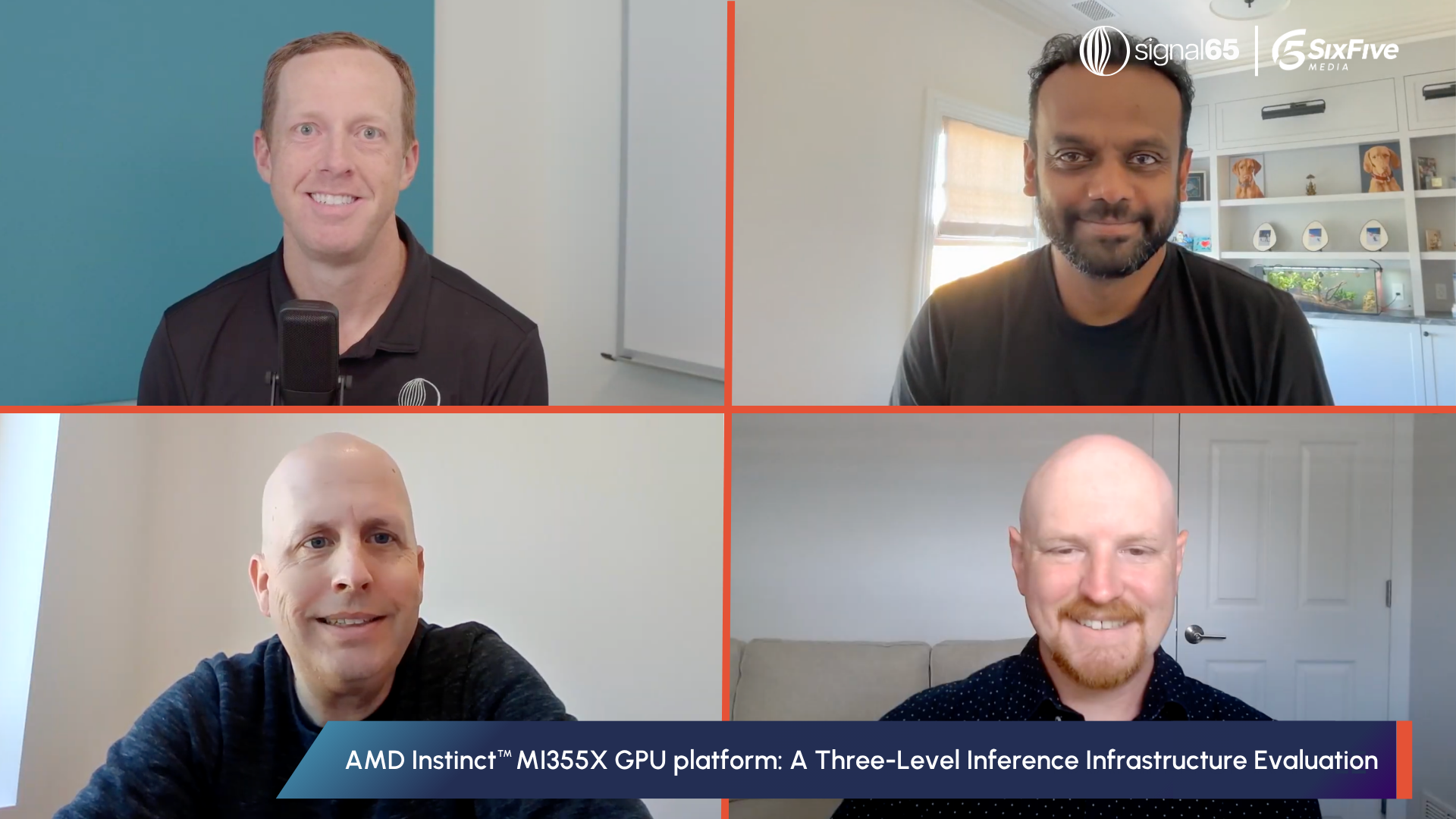
AMD Instinct MI355X vs NVIDIA HGX B200 GPU platforms AMD vs NVIDIA: A Three-Level Inference Infrastructure Evaluation
Signal65 President Ryan Shrout and Senior Performance Analyst Mitch Lewis review a new three-level inference infrastructure evaluation of AMD's Instinct MI355X against NVIDIA's HGX B200 with AMD's Andrew Dieckmann and Anush Elangovan. The MI355X's memory bandwidth advantage compounds as context and concurrency scale, delivering up to 2.25x throughput gains and roughly 40 percent lower cost per GPU hour.
.png)
Anthropic’s AI Slowdown, OpenAI’s $1.2T Valuation & Salesforce’s AI Bet
Anthropic's "Pace the Frontier" essay set off a week in which nearly every major AI leader, and two heads of state, weighed in on whether the frontier should slow down. Patrick Moorhead and Daniel Newman read the incident as something larger than a safety debate. Whoever sets the pace of the frontier also sets the pace for open-weight models, enterprise custom models, and the trillion-dollar valuations riding on top of them. That contest, not the essay itself, is the through-line of Episode 320 of The Six Five Pod.
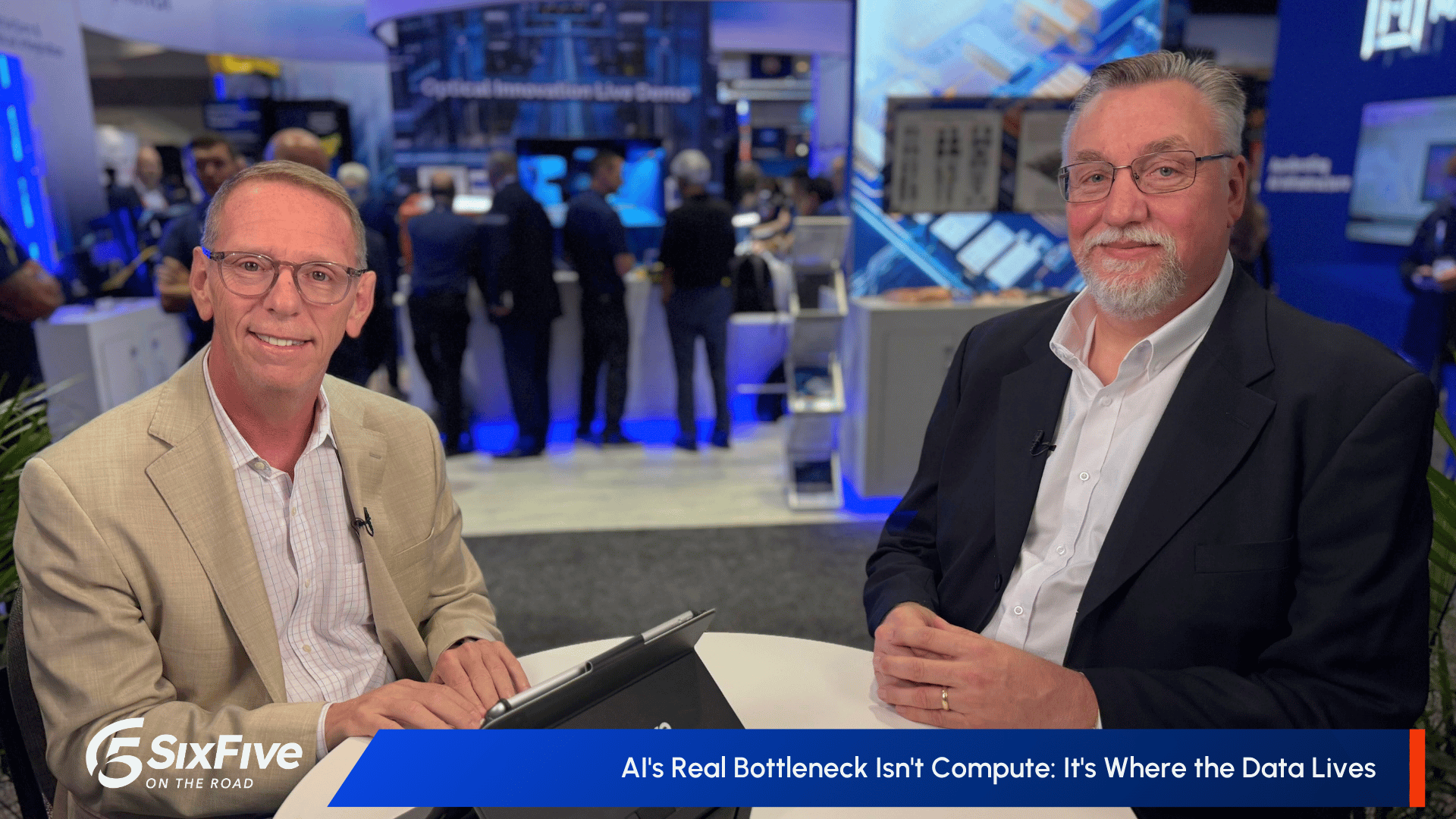
WD's Tim Rausch: AI Storage Demand Compounds With Every GPU Cycle
Western Digital's Tim Rausch argues that AI's compounding data growth, more than GPU capacity, sets the real ceiling on infrastructure scaling. He joins Matt Kimball at AI InfraSummit 2026 to walk through how total cost of ownership, archived data reuse, and WD's capacity roadmap are reshaping enterprise plans to scale AI over the next several years.
.png)
The Main Scoop Ep. 45: Attackers Only Need to Be Right Once. AI Just Made That Easier.
Chad Rikansrud, R&D Software Security Engineer at Broadcom, explains how frontier AI models are finding decades-old mainframe vulnerabilities in seconds, collapsing the complexity advantage that once protected legacy platforms. He outlines why enterprises need faster Security Intelligence (SECINT) ingestion and disciplined human oversight to keep pace with adversaries wielding the same tools.